
Where the game lives
Six structures—rules, goals, feedback, uncertainty, choice, play—map any game-like thing; the missing ones explain why it does or doesn’t feel like a game.
In this essay · 5 sections
The game lives in six structures: rules, goals, feedback, uncertainty, choice and play. Most things that feel game-like have some of them, and few non-games have all six. Asking which are present and which are missing explains, case by case, why a fitness tracker or a loyalty card feels faintly like a game without ever becoming one, and why a flight simulator can be a game for one person and an instrument for another.
Why not just define “game”
There is a long tradition of trying to say exactly what a game is, and it is worth knowing why this channel does not simply pick a winner. Ludwig Wittgenstein used games as his central example of a concept with no single shared essence: board games, card games, ball games and children’s games, he argued in Philosophical Investigations, are linked by overlapping similarities, a family resemblance, rather than one common feature. Bernard Suits wrote The Grasshopper (1978) partly to prove him wrong, and arrived at the most famous definition in the field: playing a game is “the voluntary attempt to overcome unnecessary obstacles.”
Others followed with their own. Katie Salen and Eric Zimmerman, in Rules of Play (2003), compared eight earlier definitions before offering theirs: “A game is a system in which players engage in an artificial conflict, defined by rules, that results in a quantifiable outcome.” Jesper Juul, first in a 2003 paper and then in Half-Real (2005), proposed a “classic game model” of six features: rules; a variable, quantifiable outcome; values assigned to the possible outcomes; player effort; a player who is attached to the outcome; and consequences that are negotiable in the wider world.
Each of these definitions is useful, and each draws a line. The trouble is that the interesting objects—a fitness app, a grading system, a reward card, a simulation—sit on or near the line, and a yes-or-no verdict tells you very little about them. Juul saw this clearly. His model is drawn as a center with borderline cases around it, and the borderline cases are where it does its most interesting work. The lens proposed here takes that approach one step further: instead of a boundary, a profile.
Six structures
Each of the six structures is drawn from that tradition. None of them is new. What the lens adds is the habit of checking them one at a time.
Rules constrain how the player may act. Suits’s example is golf: the goal is to get a ball into a hole, and the rules forbid the most efficient way of doing it, which is to walk over and drop it in. Rules are what make the obstacles unnecessary.
Goals are states the player is trying to reach. Suits called them prelusory goals, describable apart from the game; Juul’s model requires that outcomes be valued, so that some count as winning and others as losing.
Feedback is the system telling the player what their actions did. Salen and Zimmerman locate meaningful play in the relationship between player action and system outcome, and argue that the relationship has to be both discernible, so the player can perceive it, and integrated into the larger game. This is the feedback loop that most game-like systems are built around.
Uncertainty means the outcome is not known in advance. Roger Caillois, in Man, Play and Games, listed uncertainty among the essential qualities of play, and Greg Costikyan’s Uncertainty in Games (2013) argues that games depend on it to hold a player’s interest. A certain outcome is a procedure.
Choice is decision that changes the outcome. Juul’s “player effort” and Salen and Zimmerman’s meaningful play both depend on it. It is also what the Field Guide calls player agency.
Play is the attitude: voluntary participation, undertaken for the sake of the activity. Suits called it the lusory attitude, the acceptance of rules because they make the activity possible. Caillois insisted that play must be free, and that an activity people are forced into stops being play. Play is the odd one among the six, because it lives in the player rather than the system. A designer can invite it but cannot install it.
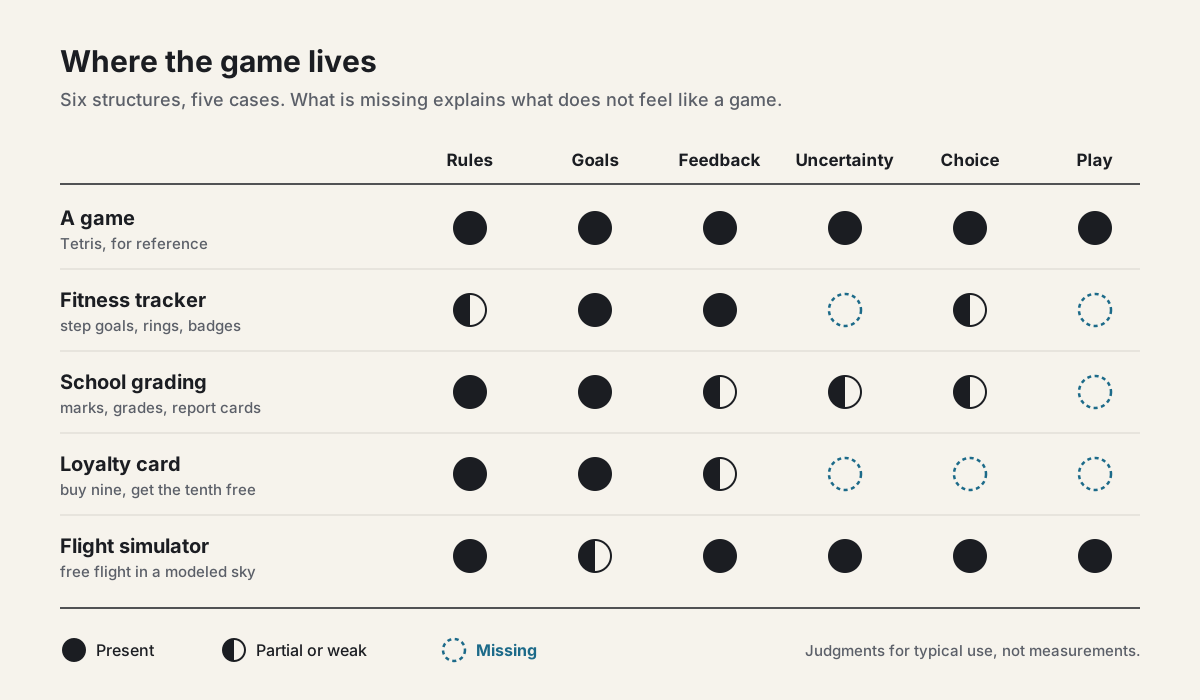
Four cases
The figure compares four game-like things with a game used for reference. Tetris (Alexey Pajitnov, 1984) has all six: fixed rules for how pieces fall and rotate, a goal of clearing lines and surviving, constant feedback, a random sequence of pieces, a choice for every piece, and nobody has to play it.
A fitness tracker is built almost entirely from goals and feedback. A daily step target, rings that close, a badge for a personal record. Its rules are thin: it counts, but it does not constrain how you reach the count, which is why a walk to the shops and a hike score the same. Choice is partial; you decide when and how to move, but the tracker offers few decisions of its own. Uncertainty is missing, since nothing in the system is unknown except your own discipline. And play is missing in Suits’s precise sense: the obstacle is not unnecessary. The steps are the point. That is why a tracker can feel motivating and still not feel like a game.
School grading has strong rules and strong goals. Its feedback is partial—often delayed by weeks and compressed into a single letter. It has some uncertainty and some choice, though both are narrowed by a fixed curriculum and fixed assessments. What it decisively lacks is play, because it is compulsory. Many attempts to make school feel like a game add more feedback, which is the one structure that was already present, and leave untouched the one that is missing.
A loyalty card is the minimal case. Buy nine coffees, get the tenth free. It has a rule and a goal, and its stamps give a little feedback. There is no uncertainty, no meaningful choice, and no play: it is a discount paid in installments. It is the purest example of the pattern described in Gamification is not a game, where the most visible parts of games are applied to an activity and the rest are left behind.
A flight simulator reverses the pattern. Microsoft Flight Simulator (Asobo Studio, 2020) has rich rules in the form of modeled physics and aircraft systems, constant feedback, real uncertainty from weather and from the player’s own skill, and dense choice at every moment of a flight. People fly it voluntarily and for its own sake. What it often lacks is a goal set by the system. Free flight has no score and no win state; the pilot decides what counts as success. Juul places open-ended simulations such as SimCity (Maxis, 1989) at the edge of his model for the same reason: they do not assign value to outcomes. That single half-filled dot is why people argue about whether a flight simulator is a game. It is a simulation game for the pilot who sets herself a landing to grease in a crosswind, and an instrument for the pilot rehearsing a real approach.
What the missing structures explain
Read the figure down its columns rather than across its rows and a pattern appears. Rules, goals and feedback are present almost everywhere. They are the administrative structures: an organization can write them down, count them and display them. Uncertainty, choice and play are the ones that go missing, and they are missing for a reason. Uncertainty means accepting that people will sometimes fail in ways you did not plan. Choice means giving up control of the outcome. Play cannot be required at all, since requiring it destroys it.
Rules, goals and feedback can be installed. Uncertainty, choice and play have to be designed for, and play cannot be required at all.
This also clarifies a distinction from Caillois that Sebastian Deterding and his co-authors later used to map gamification and its neighbors. Caillois described a spectrum running from paidia, free and improvised play, to ludus, play disciplined by rules and arbitrary difficulties. In the lens, ludus is the profile heavy in rules and goals; paidia is the profile heavy in play and choice, with goals weak or absent. The flight simulator in free flight leans toward paidia, which is why it feels like play even when it does not feel like a game. That is the territory the Field Guide calls playful design.
The pattern tells you where to look when something feels wrong. A system with rules, goals and feedback but no choice will feel like a chore with a scoreboard. A system with choice and uncertainty but no feedback will feel arbitrary. A system with everything except play will feel like a game you were assigned, which is the familiar fate of many serious games placed in classrooms and workplaces: the designers built the game, and the context removed the play.
Using the lens
The lens is not a definition and does not pretend to be one. Its ratings are judgments, and they change with context and with the player. Play especially is a relation between a person and an activity, not a property of the activity; the same flight simulator, the same running app, sits in a different row for different people. The dots in the figure describe typical use, and they are meant to be argued with.
What the lens offers is a better question. “Is this a game?” invites a verdict and ends the conversation. “Which of the six structures does this have, and which is missing?” invites a description, and descriptions can be compared, tested and improved. The same move applies inside games. Why “RPG” stopped meaning anything argues that a genre label stopped working when one of its parts, a progression system that is mostly feedback, spread everywhere; splitting the label into separate axes was the remedy there, as splitting “gameness” into separate structures is here.
Suits’s definition still holds up remarkably well, and it already contains most of the lens: rules in the obstacles, goals in the attempt, play in the word “voluntary.” What the six structures add is a way of holding a fitness tracker, a report card, a coffee card and a flight simulator up against the same light. The game is not a substance that something either contains or lacks. It lives in particular structures, and when one of them is missing, you can usually feel exactly where.
Terms in this essay
Games discussed
- TetrisAlexey Pajitnov, 1984
- SimCityMaxis, 1989
- Microsoft Flight SimulatorAsobo Studio, 2020
Sources and further reading
- BookThe Grasshopper: Games, Life and Utopia. University of Toronto Press, 1978. Reading list
- BookRules of Play: Game Design Fundamentals. MIT Press, 2003. Reading list
- BookMan, Play and Games. Free Press of Glencoe, 1961. First published in French as Les jeux et les hommes (Gallimard, 1958). Reading list
- BookHalf-Real: Video Games between Real Rules and Fictional Worlds. MIT Press, 2005. Reading list
- PaperThe Game, the Player, the World: Looking for a Heart of Gameness. Level Up: Digital Games Research Conference Proceedings, Utrecht University, 2003.
- BookPhilosophical Investigations. Blackwell, 1953. Reading list
- BookUncertainty in Games. MIT Press, 2013. Reading list
- PaperFrom Game Design Elements to Gamefulness: Defining “Gamification”. Proceedings of the 15th International Academic MindTrek Conference, ACM, 2011.
Second Playthrough is reader-supported. Members read every essay before the video goes live. Support the channel →
Working on a game, a course or a training programme? Work with me →