
Industry, Art, Media
In short Every video game is three objects at once, an industrial product, an artistic work and a medium that argues, and the most revealing parts sit where the three disagree.
The three parts
Industry
A product made inside a market, under pressures most players never see.
Ask What is it doing commercially?
Art
A work that makes feeling out of what the player does, not only out of what they watch.
Ask What feeling is the loop producing?
Media
A system that carries an argument about how the world works, whether or not anyone meant it to.
Ask What does playing it well rehearse?
The claim
Hand the same game to a market analyst, a critic and a game studies scholar and you get three documents with almost no vocabulary in common: retention curves and acquisition costs; pacing, atmosphere and the feel of failure; what the rules imply about work, debt or borders. Each can be accurate. Industry, Art, Media takes that seriously instead of calling it a matter of perspective.
A game is not one object seen from three angles. It is three objects in the same place, each fully real.
Two easy moves are ruled out. You cannot settle what a game really is by choosing the lens you like best, and you cannot treat the other two as side effects. A retention curve is something the game was built to produce, as much as the feeling of a hard fight or the argument its systems make.
How to use it
The framework is a habit more than a theory. When a moment in a game feels unusually compelling, irritating or pointed, put the three questions above to it, one per pillar.
Often only one answer turns out to be interesting, and that is fine. The useful case is when the answers pull against each other: a story that argues one thing while the game’s economy argues another. That disagreement usually marks where something real is going on, and it is the part a single lens would miss.
One loop, three descriptions
Take the daily return, the reason to open a game again tomorrow.
- As industry, it is retention. Companies watch it at day 1, 7 and 30 because it predicts lifetime value, the revenue a player brings in over their time with a game.
- As art, it is rhythm: a feedback loop tuned for mastery and the pull of one more round.
- As media, it is an argument that persistence is a virtue and accumulation is progress.
None of these is the true description with the others as commentary. All three hold at once, on one mechanic.
What each pillar draws on
Industry reads the business model: lifetime value against cost per install, retention, playtime as advertising stock in ad-funded games, and the loot box as a variable-ratio reward schedule with a payment step attached. Behind it sit Herbert Simon’s point that a wealth of information creates a poverty of attention, and Shoshana Zuboff’s account of surveillance capitalism.
Art rests on the strong case for games as art: not that they look like films, but that they have something other media lack, the loop between what a person does and how the system answers. That is interactivity, and its theory runs through Janet Murray’s player agency, Espen Aarseth’s ergodic literature and the MDA framework, in which rules produce play and play produces feeling.
Media rests on Ian Bogost’s procedural rhetoric: persuasion through rules and interactions rather than words or images. A game can make a claim by building a working model of something and handing over the controls, which is what a persuasive game does. What the model leaves out persuades as much as what it puts in.
Where the three meet
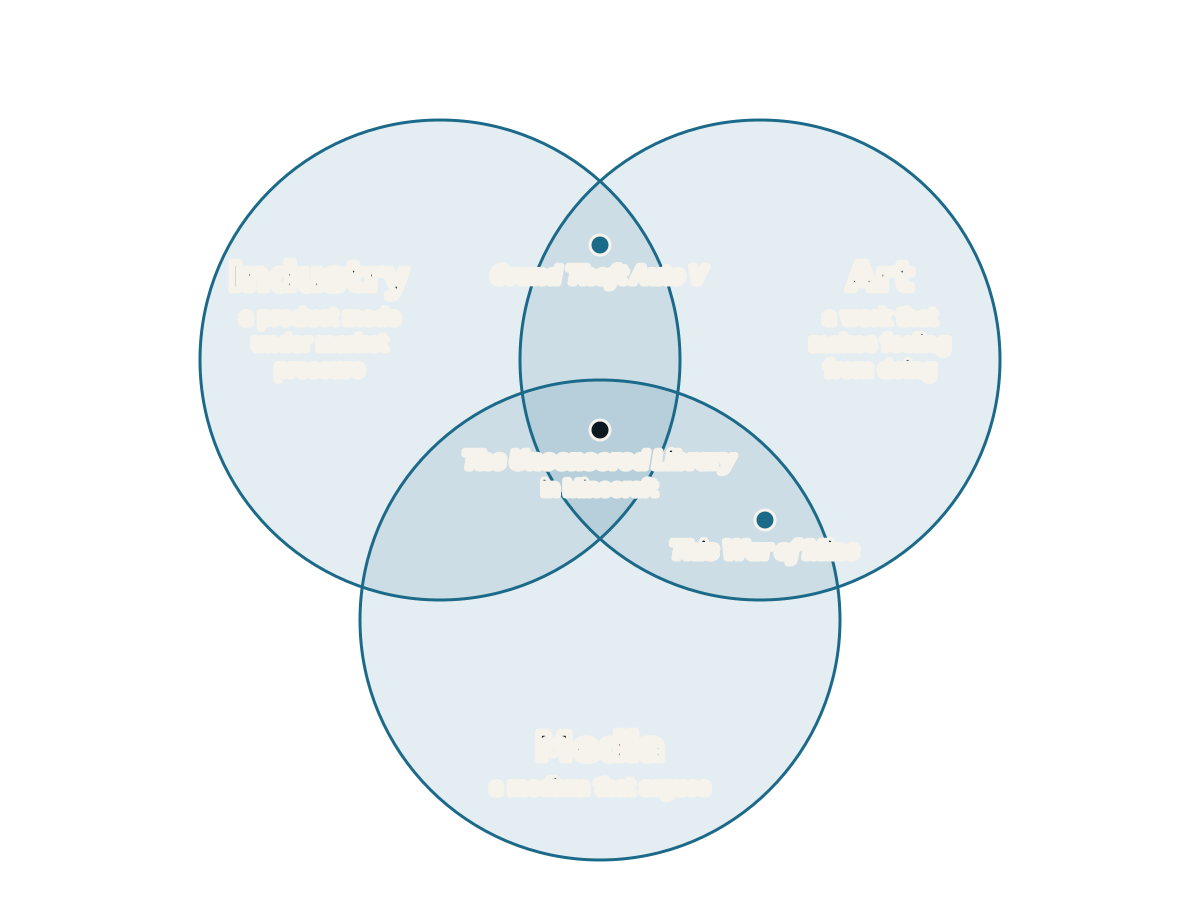
Every game has all three, but most lean on two. Grand Theft Auto V joins industry and art; This War of Mine, built around civilians in a besieged city, joins art and media. The clearest case of all three in one object is the Uncensored Library: a library of banned journalism built inside Minecraft, at once a platform’s reach, a work of architecture and a route around censorship.
Where it strains
The framework has limits, and using it well means knowing them.
- The industry lens can swallow everything. Players are not passive: they get mastery, community and structure from these systems, and high retention can simply mean a good game. A lens that explains every pleasure as a metric has stopped explaining.
- Meaning does not live in the rules alone. Miguel Sicart argues that players are creative agents who bend what a design intends. The art and media answers depend on who is playing; the rules set up a situation, and what it means depends on what a given player does there.
- The technique does not choose its side. The same procedural tools carried banned journalism past censors and a sanitised picture of military service to teenagers. The framework can show how a game persuades; whether that is good is a separate judgement.
- It is one way to sort games, not the only one. Its claim is narrower: keeping all three in view at once explains things that each one, alone, misses.
Set out in
Industry, Art, Media: What Video Games Actually Are
A video game is three things at once: an industrial product, an artistic work and a medium that argues. The most revealing parts of a game sit where the three meet.
Terms on this page
Sources
- BookPersuasive Games: The Expressive Power of Videogames. MIT Press, 2007. Reading list
- BookHamlet on the Holodeck: The Future of Narrative in Cyberspace. Free Press, 1997. Reading list
- BookCybertext: Perspectives on Ergodic Literature. Johns Hopkins University Press, 1997. Reading list
- PaperMDA: A Formal Approach to Game Design and Game Research. 2004.
- PaperAgainst Procedurality. Game Studies 11(3), 2011.
- PaperAre Video Games Art?. Contemporary Aesthetics, 2005.