
Industry, Art, Media: What Video Games Actually Are
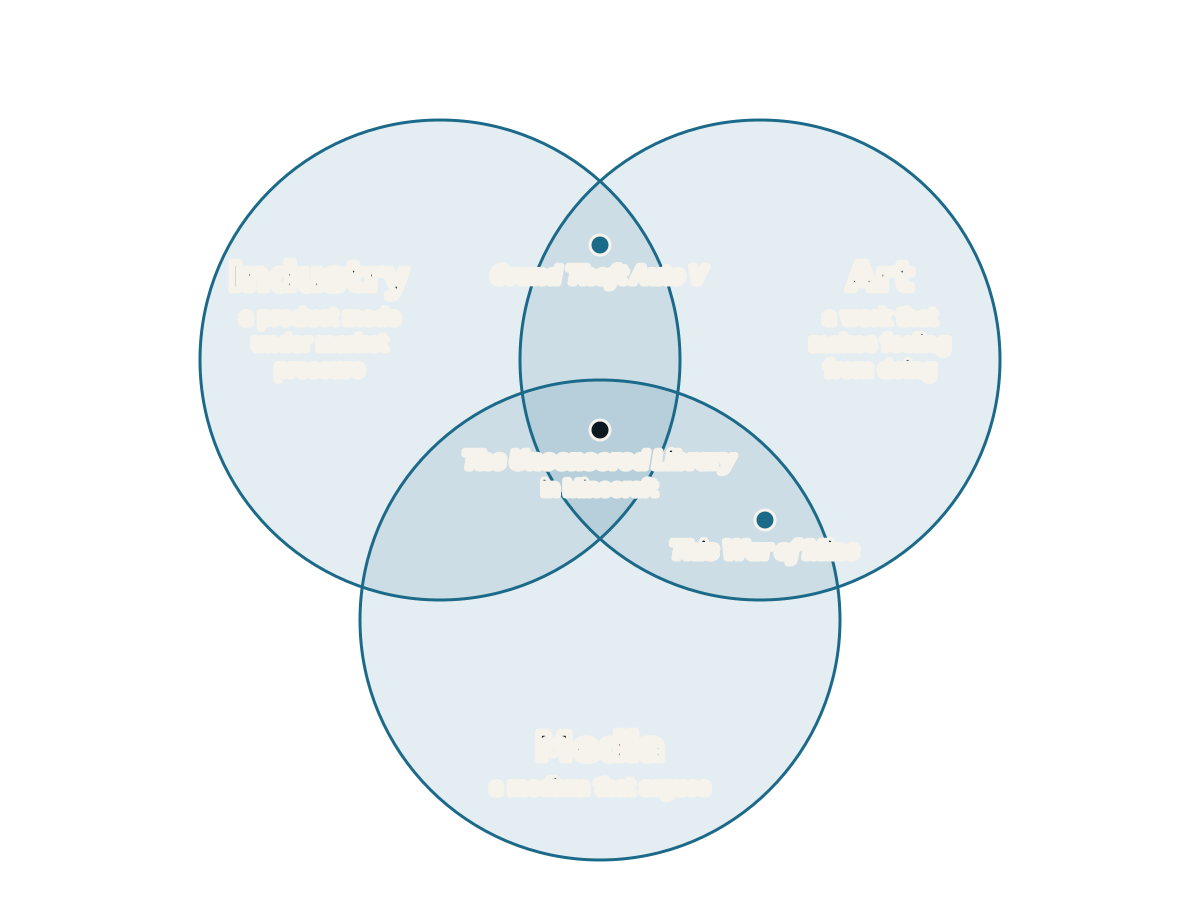
A video game is three things at once: an industrial product, an artistic work and a medium that argues. The most revealing parts of a game sit where the three meet.
 Watch the video essay
A video game is three things at the same time: an industrial product made under market pressures most players never see, an artistic work that produces feeling through what the player does, and a medium that carries arguments about how the world works. These are not three angles on one object. They are three objects in the same space, each fully real, and the most revealing parts of a game sit where they meet or disagree.
Three descriptions of the same object
Read three documents about the same mobile game. A market analyst’s report describes retention curves, acquisition costs and average playtime. A critic describes pacing, atmosphere and how it feels to fail. A game studies paper describes what the rules imply about work, debt or borders. They share almost no vocabulary, and none of them is wrong.
Calling these perspectives undersells them. The retention curve is not a view of the game; it is part of what the game was built to produce, and so are the feeling of failure and the argument about debt. This essay takes the three in turn, then looks at one object where they cannot be pulled apart.
The engine of capital
Before a modern commercial game is a story or a world, it is a business plan. In mobile games the plan rests on one inequality: lifetime value (LTV), the revenue a player generates over their time with a game, must exceed cost per install (CPI), the ad spend needed to acquire them. Supersonic, a hyper-casual publisher, puts the target CPI for a prototype at under about $0.30.
Companies forecast LTV from early behaviour. They watch retention at day 1, 7 and 30; by one industry estimate, about three-quarters of games fall below 3% at day 28. They watch daily over monthly players, where about 20% counts as healthy. And in hyper-casual they watch APPU, average playtime per user. It is easily confused with ARPPU, average revenue per paying user, but it is a time figure. Supersonic created it as a predictor of lifetime value and treats a day-7 APPU above 2,000 seconds as a sign a prototype is ready for soft launch.
A time metric is weighted like a revenue metric because, in an ad-funded game, playtime is advertising inventory. My reading: the number that looks like a measure of enjoyment is, in the business model, a measure of stock. The order of work says the same. Studios commonly make a short video ad for a concept before building it and drop it if installs per thousand impressions (IPM) are weak. The audience is tested first, and the game is built to pass the test.
Voodoo, the best-known hyper-casual publisher, worked with several hundred partner studios at its peak. After Apple’s 2021 change to its advertising identifier (IDFA) raised acquisition costs, Voodoo cut the network and pivoted to “hybrid-casual” games with deeper progression and purchases. By 2023, by one estimate, hyper-casual was about a quarter of its revenue. A privacy setting in an operating system changed which games were made.
Elsewhere in the industry, money comes from fewer players spending more. In a 2018 PLoS ONE survey of 7,422 gamers, David Zendle and Paul Cairns found that loot-box spending was linked to the severity of problem gambling, more strongly than spending on non-random items. The finding is correlational. It cannot show whether loot boxes cause gambling problems or attract people who already have them. The mechanism behind random rewards is well documented: B. F. Skinner’s variable-ratio schedule, in which unpredictable rewards make a behaviour persist. A loot box is that schedule with a payment step attached. The mechanism is neutral; what changes is what sits at the end of it.
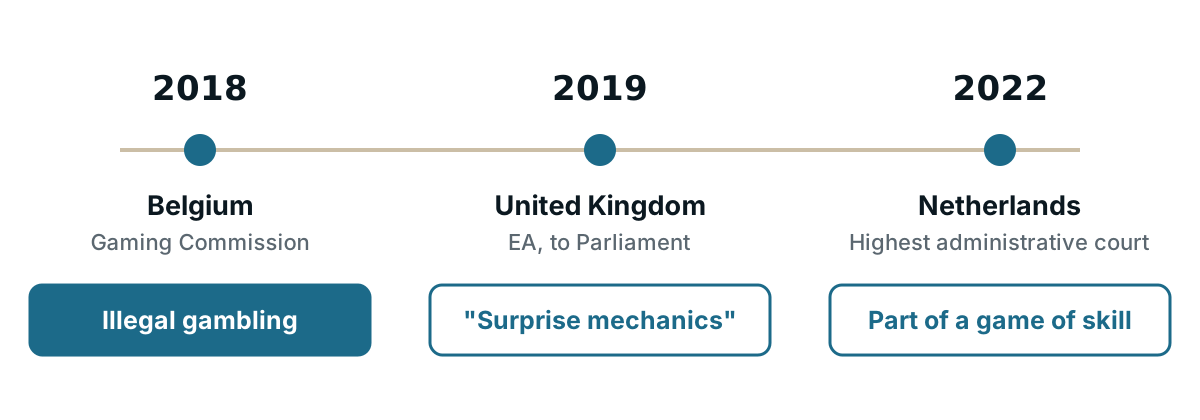
Regulators disagree about what that is. In 2018 Belgium’s Gaming Commission ruled paid loot boxes illegal gambling, and EA later stopped selling FIFA Points there. In 2019 an EA executive told a UK parliamentary committee that Ultimate Team packs were “surprise mechanics”. In 2022 the Netherlands’ highest administrative court overturned a €10 million fine against EA, treating the packs as part of a game of skill. Identical mechanics, opposite conclusions.
On 4 August 2026, a consortium of Saudi Arabia’s Public Investment Fund (PIF), Silver Lake and Affinity Partners completed a roughly $55 billion buyout of Electronic Arts, the largest leveraged buyout on record. Shareholders received $210 a share, and PIF came to hold about 93.4%. EA had reported fiscal 2026 net bookings of about $8.03 billion. Industry trackers, not EA, estimate that Ultimate Team makes up roughly half of its approximately $4.4 billion in “extra content.” My interpretation, which reasonable people dispute, is that a debt-financed owner has strong reasons to prize exactly that kind of recurring revenue.
Grand Theft Auto V shows the logic inside one game. As of Take-Two’s fiscal Q4 2026 disclosure it had sold about 230 million units, second only to Minecraft. Its online mode sells currency for real money, and a 2022 leak suggested over $5 billion in microtransaction revenue, more than $1 million a day. That figure is leaked, not audited. I read this as a story about incentives rather than greed: when one use of a studio’s time pays once and another pays every day, the spreadsheet has an answer.
Behind this sits Herbert Simon’s 1971 observation that a wealth of information creates a poverty of attention. Shoshana Zuboff later named the system that turns recorded behaviour into predictions and revenue: surveillance capitalism.
This lens has limits. Players are not passive; they get mastery, community and structure from these systems. A high spender may be in trouble or may be an adult enjoying a hobby, and research often cannot tell them apart from outside. High retention can simply mean a good game. A lens that explains every pleasure as a metric has stopped explaining anything.
The pillar also has an edge that has nothing to do with manipulation. On 23 January 2023, Blizzard’s games, World of Warcraft among them, went offline in mainland China when its 14-year licensing agreement with NetEase expired. It was a failed commercial negotiation, not a government decision. About 3 million players lost access, and players called downloading their character data “cremation.” The games returned in 2024 under a renewed deal. Everything those players built existed under a contract they could not see. NetEase returns in the library.
The aesthetics of agency
The film critic Roger Ebert argued in 2005 and 2010 that games could not be art. His objection was structural: rules, objectives and winning make them closer to sport or craft. He later conceded he had judged a medium he did not intend to explore.
Institutions moved faster than the argument. On 13 March 2006, France made Shigeru Miyamoto, Michel Ancel and Frédérick Raynal knights of the Ordre des Arts et des Lettres; Miyamoto said Nintendo’s early games had been conceived by technicians, not artists. In 2011 the National Endowment for the Arts made games eligible for funding. In 2012 the Smithsonian American Art Museum mounted “The Art of Video Games,” and MoMA acquired 14 games, including Pac-Man and Tetris. Its curator, Paola Antonelli, defended them as interaction design.
In 2005 the philosopher Aaron Smuts asked “Are Video Games Art?” and, instead of defending one definition, tested games against each major one. He concluded that many modern games qualify under any of them. Not every defence helps. Berys Gaut’s 2010 description of the video game as essentially interactive cinema is generous, but it makes games a subspecies of film.
The weak case for games as art points to cinematic visuals and concedes the point by measuring games against older forms. The strong case says games are distinctive because of the one thing other media lack: the loop between what a person does and how the system responds. The essay on telling, showing and doing follows that difference across books, films and games.
The strong case has an unlikely endorsement. In June 2011, in Brown v. Entertainment Merchants Association, the US Supreme Court ruled 7–2 that video games are protected speech. Justice Scalia’s majority opinion protected them for sharing literary devices with books and film and for features distinctive to the medium, naming the player’s interaction with the virtual world. A court located part of games’ expressive value in interactivity itself.
The theory dates to 1997. Janet Murray’s Hamlet on the Holodeck named agency as a pleasure of digital environments: the satisfying power to take meaningful action and see its results, what the Field Guide calls player agency. Espen Aarseth’s Cybertext described ergodic literature, where nontrivial effort is needed to traverse the text. A novel’s words arrive in a fixed order. A game’s path does not exist until someone makes it.
The difference between doing and watching has also been measured. HopeLab’s Re-Mission (2006) was built to help young people with cancer stick to their treatment. A randomised controlled trial of 375 patients aged 13 to 29, at 34 centres in the US, Canada and Australia, was published in Pediatrics in August 2008. Adherence was measured with blood chemotherapy levels and electronic pill-cap monitors, not self-report. The game group showed better adherence, cancer knowledge and self-efficacy. Self-reported adherence did not change; only the objective measures did. A follow-up imaging study found that active play engaged reward circuits that passively viewing the same content did not. Only the acting differed.
Film audiences are not passive either; Stuart Hall’s reception theory showed viewers interpreting and resisting what they see. The real difference is narrower. In film, interpretation is the viewer’s contribution and the text stays fixed. In a game, the player partly produces the text.
That is how games make feeling out of rules. These readings are mine, not sourced claims. Shadow of the Colossus spreads guilt across its climb-and-kill loop: the killing takes long enough, and happens close enough, that you have time to feel it. Brothers: A Tale of Two Sons puts a brother on each analogue stick, trains your hands in that split control for hours, then uses the habit to deliver grief. Journey removes ordinary communication between players, and the connection between strangers comes from the restriction. The MDA framework of Robin Hunicke, Marc LeBlanc and Robert Zubek describes the direction: mechanics produce dynamics, which produce aesthetics, the player’s emotional response.
If games speak through story and through systems, the two can disagree. In 2007 Clint Hocking called that ludonarrative dissonance, writing about BioShock, whose story criticises ruthless self-interest while its systems reward it.
Miguel Sicart objects that meaning does not live inside rules: players, he argues, are creative agents who subvert intended meaning. I think he is right that rules alone do not contain the art. The art happens where a designed system meets a particular player, which is why two people can finish the same game with different accounts of it. The mirror and the machine takes up what those accounts reveal about the people giving them.
Procedural rhetoric
In Persuasive Games (2007), Ian Bogost named procedural rhetoric: persuasion through rule-based representations and interactions, rather than speech, writing, images or moving pictures. A game can make a claim by building a working model of how something operates and handing over the controls. Bogost links this to the classical enthymeme, an argument whose missing premise the audience supplies. In a game, the player supplies it by playing. A game built this way is a persuasive game.
The McDonald’s Videogame (Molleindustria, 2006) runs on four screens: pasture, feedlot, restaurant and headquarters. Play ethically and you go bankrupt. The claim is structural: this system, as modelled, needs compromise to stay solvent. McDonald’s called it a complete misrepresentation. Yet Paolo Pedercini chose the variables; another designer could build a model where ethics pay. Systems feel like descriptions even when they are assertions.
Depression Quest (2013), by Zoë Quinn, Patrick Lindsey and Isaac Schankler, is almost all text. Its decisive mechanic shows healthy choices on screen but strikes them through and makes them unclickable. You can see the right decision and cannot select it. A sentence can say that depression is a gap between knowing and doing; the mechanic makes you sit in it. It was later caught up in the 2014 Gamergate harassment campaign, a history separate from the design.
Papers, Please (Lucas Pope, 2013) gives a border inspector a rulebook that grows daily and a family budget that rarely closes. Compassion at the booth costs your family money. Scholars have read it through Hannah Arendt’s banality of evil and Max Weber’s iron cage, and the game earns both through its rules rather than its story.
All three are critiques by small teams aimed at institutions, which on its own is a misleading sample. On 4 July 2002 the US Army released America’s Army, a free shooter conceived by Colonel Casey Wardynski after a late-1990s recruiting shortfall, at a reported cost of about $7.3 million to $12 million. A 2008 MIT study, as reported by Vice, found that 30% of Americans aged 16 to 24 viewed the Army more positively because of the game, and that it had more impact on recruits than all other Army advertising combined. A year after release, about 20% of West Point recruits said they had played it. The servers shut down in 2022.
Its rules encoded training, teamwork and penalties for friendly fire. Researchers note its content was sanitised to show the military in a uniformly positive light. What a simulation leaves out persuades as strongly as what it includes, because the player experiences the omission as the shape of reality. America’s Army made its point by never letting the doubtful situation arise.
Procedural rhetoric is a technique, not a politics. It also produced Darfur is Dying, about a refugee camp, and A Force More Powerful, about nonviolent resistance, both kin of games for change. Same mechanism, different sponsors.
Sicart’s sharpest objection, in “Against Procedurality” (2011), is that proceduralism denies the player as an individual. America’s Army supports him: many people played it as a good free shooter and enlisted in nothing. The strongest version of Bogost’s idea is not that rules transmit meaning directly. It is that rules create a situation, and meaning comes from what a particular person does inside it.
The Uncensored Library
Most games sit between two pillars. Grand Theft Auto V joins industry and art. This War of Mine (11 bit studios, 2014), informed by the Siege of Sarajevo, joins art and media: you play civilians, not soldiers. The object where all three meet is a building in Minecraft.
Microsoft bought Minecraft from Mojang in 2014 for $2.5 billion. The game passed 300 million copies sold in 2023, the best-selling video game of all time, and Reporters Without Borders (RSF) cited over 145 million monthly players at launch.
RSF commissioned the Uncensored Library with BlockWorks, led by James Delaney, the agency DDB Berlin and the production company MediaMonks. It opened on 12 March 2020, the World Day Against Cyber Censorship, under the line “Truth Finds A Way.” About 24 builders from 16 countries spent about 250 hours over three months placing about 12.5 million blocks. The building is neoclassical, its dome and central hall echoing civic libraries such as the New York Public Library. My reading is that the style is part of the argument: it presents banned journalism as civic heritage, not contraband.
Its wings cover Mexico, Russia, Vietnam, Saudi Arabia and Egypt, with work by Jamal Khashoggi, Javier Valdez Cárdenas and Nguyen Van Dai, and by the outlets Grani.ru and Mada Masr. The articles are in-game books in English and their original languages, readable but not editable. The map can be downloaded as well as visited on a server.
So the library is a platform’s reach, a work of architecture and a route for banned journalism at once. It also carries each pillar’s tensions. The widely quoted figure of 25 million players traces to the campaign team, not an independent audit, and visits are not evidence of readers in censored countries. It was an award-winning ad campaign, recognised at Cannes Lions, the Webbys and the One Show, and also an act of resistance. Both are true.
It exists under Microsoft’s terms of service and moderation, and commentators noted at launch that a government could block Minecraft outright. Mainland China’s Minecraft is a separate, moderated edition licensed to NetEase, which the global project does not reach. That is the company whose expired licence took Blizzard’s games offline. This is a structure, not a conspiracy: foreign games in China need a domestic partner, so a few companies hold that gate and the same names recur.
One juxtaposition needs care. One wing is devoted to Saudi Arabia and honours Khashoggi. In August 2026, Saudi Arabia’s Public Investment Fund completed its purchase of EA. There is no connection between those facts, and nothing suggests interference with the library. The point is ownership of the medium. The question the library was built to raise, who controls the space where things can be said, now applies to an industry increasingly owned by state-level capital.
What the second look gives you
Take one loop, the daily return. To a business it is retention, a number that predicts lifetime value. To a designer it is rhythm, a feedback loop tuned for mastery and the pull of one more round. To a reader of games as media it is an argument that persistence is virtue and accumulation is progress. One mechanic, three accurate descriptions, true at once.
A game is not one object seen from three angles. It is three objects at the same time, and none of the descriptions cancels the others.
The best evidence that these are forces and not only categories is that one technique serves opposite ends. RSF used a game to carry banned journalism past censors. The US Army used one to carry a sanitised picture of service to teenagers, and by the reported MIT figures it outperformed the Army’s other advertising. Nothing in the technique chooses between them. This is why Alexander Galloway treats games as actions rather than images, and why Nick Dyer-Witheford and Greig de Peuter call games a medium of global capitalism: enjoyment is how a system’s logic becomes intuitive. Bogost’s word for the hollow version, game mechanics used to extract behaviour, is “exploitationware.”
Jane McGonigal’s Reality Is Broken argues the other side: games bring out real human capacities. Re-Mission is strong evidence for her, a serious game that measurably helped young patients keep to their treatment using the mechanisms this essay has examined. The conclusion is not that games are bad. It is that one mechanism can build a library, a recruiting tool or better adherence to chemotherapy, and the difference lies where industry, art and media meet, not in the mechanic.
The practical habit is three questions for any moment that feels unusually compelling, irritating or pointed. What is it doing commercially? What feeling is the loop producing? What does playing it well rehearse? Often only one answer is interesting. When the answers disagree, as when a game’s story argues one thing and its economy another, you have usually found the place where something real is going on.
Video chapters
Framework in this essay
- Industry, Art, MediaSet out here. Every video game is three objects at once, an industrial product, an artistic work and a medium that argues, and the most revealing parts sit where the three disagree.
Terms in this essay
Games discussed
- Grand Theft Auto VRockstar North, 2013
- EA Sports FCEA Vancouver and EA Romania, 2023
- World of WarcraftBlizzard Entertainment, 2004
- Shadow of the ColossusTeam Ico, 2005
- Brothers: A Tale of Two SonsStarbreeze Studios, 2013
- Journeythatgamecompany, 2012
- BioShock2K Boston, 2007
- Re-MissionHopeLab, 2006
- The McDonald's VideogameMolleindustria (Paolo Pedercini), 2006
- Depression QuestZoë Quinn, Patrick Lindsey and Isaac Schankler, 2013
- Papers, PleaseLucas Pope, 2013
- America's ArmyUnited States Army, 2002
- This War of Mine11 bit studios, 2014
- MinecraftMojang, 2011
Sources and further reading
- BookPersuasive Games: The Expressive Power of Videogames. MIT Press, 2007. Reading list
- PaperVideo game loot boxes are linked to problem gambling: Results of a large-scale survey. PLoS ONE, 2018. Correlational survey of 7,422 gamers; it does not show causation.
- PaperA video game improves behavioral outcomes in adolescents and young adults with cancer: A randomized trial. Pediatrics, 2008. Link is a university news summary of the trial.
- ReportBrown v. Entertainment Merchants Association, 564 U.S. 786. Supreme Court of the United States, 2011. Link is the Free Speech Center summary of the case.
- PaperAre Video Games Art?. Contemporary Aesthetics, 2005.
- PaperAgainst Procedurality. Game Studies 11(3), 2011.
- BookHamlet on the Holodeck: The Future of Narrative in Cyberspace. Free Press, 1997. Reading list
- BookCybertext: Perspectives on Ergodic Literature. Johns Hopkins University Press, 1997. Reading list
- PaperMDA: A Formal Approach to Game Design and Game Research. 2004.
- BookHalf-Real: Video Games between Real Rules and Fictional Worlds. MIT Press, 2005. Reading list
- ArticleLudonarrative Dissonance in BioShock. 2007.
- ArticleThe 3 most important KPIs for testing your hyper-casual prototype. Supersonic. Industry guidance from a publisher, not independent research.
- WebsiteLeveraged buyout of Electronic Arts. Wikipedia. Deal closed on 4 August 2026; figures as of August 2026.
- ArticleElectronic Arts taken private as $55bn Saudi-led acquisition is finalized. Neowin, 2026.
- ArticleGTA Online and the $5 billion in Shark Cards. Tech4Gamers. Based on a 2022 leak; not audited.
- ArticleChinese WoW servers shut down after 14 years following expiration of NetEase agreement. GameSpot, 2023.
- ArticleHeartbroken gamers mourn World of Warcraft's shutdown in China. Rest of World, 2023.
- ArticleFrom Paris with love: de Chevalier dans l'Ordre des Arts et des Lettres. Game Developer, 2006.
- ArticleAmerica's Army, the Pentagon's video game, shuts down after 20 years. Vice, 2022. Reports the 2008 MIT study on the game's effect.
- PaperBeyond America's Army. Security Dialogue.
- WebsiteRSF opens The Uncensored Library, a digital home for press freedom within a global computer game. RSF, 2020.
- WebsiteThe Uncensored Library. Wikipedia. Reach figures for the project are self-reported by the campaign team.
- WebsiteMolleindustria's McDonald's video game. Actipedia.
- PaperDesigning Organizations for an Information-Rich World. 1971. Link is a history of the attention economy that discusses Simon's paper.
- BookThe Age of Surveillance Capitalism. PublicAffairs, 2019. Reading list
- BookGaming: Essays on Algorithmic Culture. University of Minnesota Press, 2006. Reading list
- BookGames of Empire: Global Capitalism and Video Games. University of Minnesota Press, 2009. Reading list
- BookReality Is Broken. Penguin Press, 2011. Reading list
Second Playthrough is reader-supported. Members read every essay before the video goes live. Support the channel →