
Part 1 of 2 · Games Are the Ultimate Experience
Why Games Hit Harder Than Books and Movies
Books tell and films show; games make you do, and then hold you responsible. That makes them not the highest art but the most participatory one.
 Watch the video essay
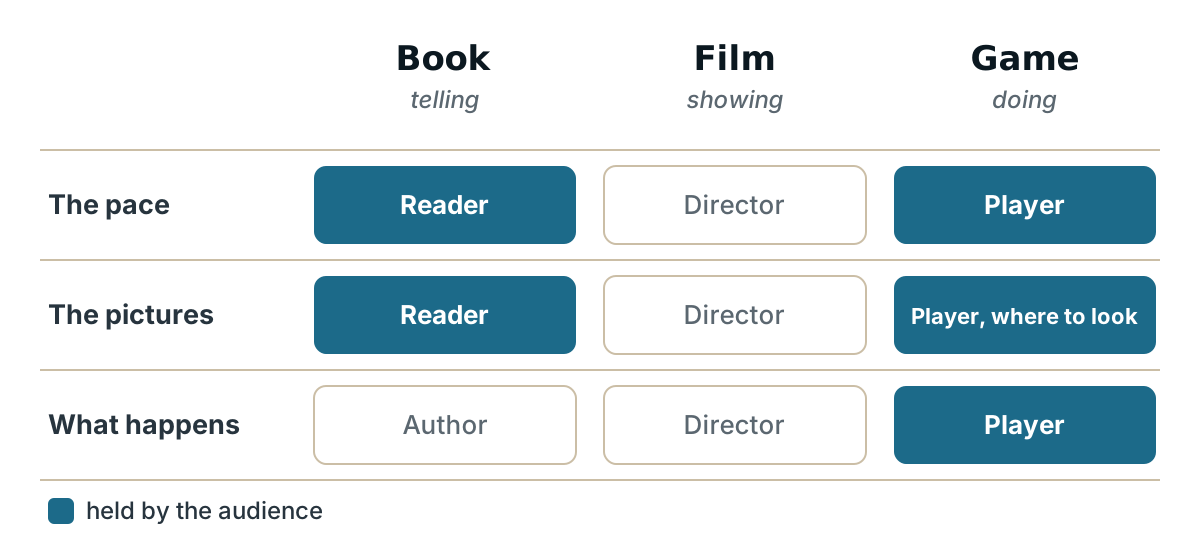
Games hit harder than books and films because they hand the audience one more kind of control: control of what happens. A novel lets the reader set the pace and supply the pictures, but it keeps the events. A film takes the pace and the pictures away and returns a precisely managed experience of watching. A game gives the events to the player, and with them, responsibility for the outcome. That shift, more than graphics or immersion, is what makes games different in kind. It does not make them the highest art. It makes them the most participatory medium we have, the only one in which the audience can feel guilt, pride or complicity about something it did rather than something it saw.
The clearest single moment comes near the end of Metal Gear Solid 3: Snake Eater (2004). Snake must shoot The Boss, the mentor who trained him. A film would cut to the shot. The game does not. It ends the cutscene, puts the gun back in the player’s hands and leaves the trigger to them. Players who refuse find, according to player accounts and the Metal Gear Wiki, that Snake eventually fires on his own. The shot was always going to happen. What the game changes is who is asked to take it.
This essay climbs a ladder of three steps: telling, showing and doing. At each step a medium gives its audience something and takes something else away.
Books: you build the world
A book contains no images, sounds or actors. It contains instructions, and the reader builds everything else. When a novel says “a cold room,” the light, the furniture and the cold come from the reader.
Psychology has measured part of this construction. In a 2009 brain-imaging study led by Nicole Speer and Jeffrey Zacks, reading about a character’s actions activated brain regions involved in performing or perceiving the same kinds of actions. The reader partly rehearses the story. Melanie Green and Timothy Brock called the deep form of this absorption “transportation”. In their 2000 experiments, readers who were more transported argued back less and were more likely to adopt the story’s beliefs. Stories persuade by absorption, not by argument.
The construction is not the same for everyone. In 2015 the neurologist Adam Zeman coined the word aphantasia for people with no voluntary mental imagery. A 2022 survey of 1,004 people by Dance and colleagues estimated that 3.9 percent have absent or vague imagery, and Zeman (2024) puts total absence at about 1 percent. Many such people love novels. Reading, it seems, is less like watching a film in your head than like following meaning, voice and feeling.
One popular claim about reading needs a warning label. In 2013 David Kidd and Emanuele Castano reported in Science that reading a short passage of literary fiction immediately improved scores on theory-of-mind tests. The replications went badly. Panero and colleagues (2016), with about 792 participants, found no effect; Samur and colleagues (2018) found none in four attempts. van Kuijk and colleagues (2018) largely replicated it but judged the original evidence weak. Kidd and Castano’s own three preregistered replications produced, by their own analysis, “two uninformative failures to replicate and one successful replication.” What holds up better is a correlation: lifetime reading habits go together with stronger social cognition. Reading may sharpen us over years; one sitting probably does not.
So the reader controls the pace, the rereading and every picture. What the reader does not control is what happens. Anna Karenina meets the same train in every copy. Twentieth-century theory insisted the experience was still open. Wolfgang Iser described texts as full of gaps that readers fill, and Roland Barthes wrote in 1967 that “the birth of the reader must be at the cost of the death of the Author.” Both are right about interpretation. Neither gives the reader a way to intervene.
Writers tested that limit on paper long before computers could. Jorge Luis Borges’s “The Garden of Forking Paths” (1941) imagined a novel in which every choice happens at once, a blueprint for branching narrative decades early. B.S. Johnson’s The Unfortunates (1969) came as a box of 27 unbound sections, with only the first and last fixed. Raymond Queneau’s Cent mille milliards de poèmes (1961) cut ten sonnets into strips, one line per strip, for 10^14 possible poems. Queneau calculated that reading them all would take about 190 million years. Espen Aarseth later named this family “ergodic literature” (1997): texts that require “nontrivial effort” to traverse. Games are its fullest form.
The experiment that reached a mass audience began as a bedtime story. Edward Packard, a lawyer, invented the format because his daughters wanted different endings. Publishers rejected his Sugarcane Island until R.A. Montgomery’s small Vermont Crossroads Press took it, and Bantam launched Choose Your Own Adventure in 1979. According to the series’ publisher, Chooseco, it sold more than 250 million copies between 1979 and 1999, in 38 languages. The more telling figure comes from the Journal of American Studies: by 1984 the books had sold over 14 million copies, while Infocom’s hit text adventure Zork had sold about 250,000. The appetite for choice came before the technology.
The book still does three things better than anything that came after it. It gives direct access to thought: no game has matched the drifting consciousness of Mrs Dalloway or the self-justifying narrator of Lolita. Disco Elysium, the closest attempt, is essentially a novel with dice. It compresses and stretches time at will, covering a century in a sentence or a second in a chapter. And its budget is infinite, since a dragon costs the writer exactly what a teacup does. That is the first step, telling. The author controls the events. The reader controls the pace and the pictures.
Film and TV: someone else holds your eyes
Cinema takes both of those away. A viewer cannot slow down, reread or look somewhere the director has not chosen. That loss is the source of film’s power.
The Kuleshov effect, from Soviet editing experiments of the 1910s and 1920s, showed that the same neutral face reads as hunger, grief or desire depending on the shot placed next to it. Meaning is made between images, in the viewer’s mind, and the editor decides which images meet. Hitchcock’s example of the bomb under the table applies the same control to knowledge. Reveal the bomb only when it explodes, and the audience gets a few seconds of surprise. Show it first, ticking, and the audience gets minutes of suspense. Film’s emotional engine is managed information: the audience knows, the character does not, and the audience can do nothing about it.
Games reverse that helplessness. A player usually knows what the character knows, and can act on it.
Roger Ebert called the movies “a machine that generates empathy.” He also argued, in 2010, that video games can never be art, because art requires an author in control and player choice undermines that control. He partly walked this back later the same year, conceding that he should not have judged games without playing them. His objection still deserves its strongest form: if the player chooses, who is the artist? It returns at the end of this essay. (The broader question of what kind of object a game is, given that a game is industry, art and media at once, has its own essay.)
Watching is not passive. Viewers infer and predict constantly, and films such as Memento and Primer turn viewing into detective work. But that agency is interpretive, not causal.
Animation adds something that games later borrowed. Scott McCloud’s Understanding Comics (1993) argues that simple, iconic faces invite stronger identification than detailed ones, because they are less clearly someone else. He calls this masking: an iconic character worn like a mask against a detailed world. Mario, Pac-Man and the faceless traveler of Journey fit the pattern: underdefined on purpose, so the player can step inside.
Television’s tool is time. A feature film lasts about two hours. A prestige series runs for dozens: Breaking Bad’s 62 episodes take roughly 45 to 70 hours. Donald Horton and Richard Wohl described parasocial interaction in 1956, the one-sided bond an audience forms with people on screen, and such bonds deepen with exposure. The cliffhanger is often explained by the Zeigarnik effect, a 1927 finding that interrupted tasks are remembered better; its replication record is mixed, so treat it as a writers’ theory, not settled psychology.
That is the second step, showing. The director controls time, the camera and what the audience knows. In return the audience gets perhaps the most refined empathy any medium offers: empathy for someone, not action as them. A viewer can love Walter White but cannot stop him.
The experiment that failed
The obvious next move is to hand the viewer a choice. Film has tried for decades.
At Expo 67 in Montreal, the Czechoslovak pavilion showed Kinoautomat. At set points a moderator paused the film and the audience voted with buttons. A critique repeated ever since is that the branches reconverged, so the vote changed little; some read that as satire on democracy itself, though that reading is interpretation, not record. Earlier, William Castle’s Mr. Sardonicus (1961) supposedly let audiences vote on the villain’s fate with glow-in-the-dark cards. Castle claimed mercy was never chosen, but many historians doubt a mercy ending was ever shot. It is best treated as a legend.
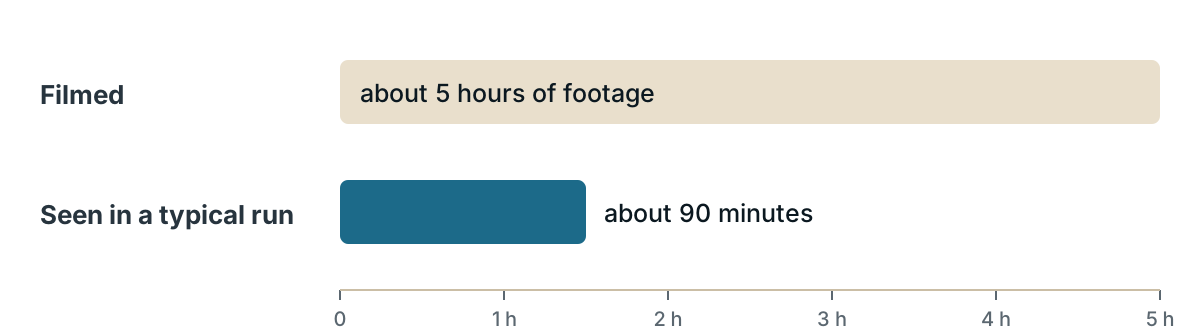
The largest attempt came in December 2018, when Netflix released Black Mirror: Bandersnatch. It held about five hours of footage, and a typical run took around 90 minutes. Netflix later released what viewers chose: over 60 percent gave the protagonist Frosties rather than Sugar Puffs, and 73 percent accepted the job at Tuckersoft. The least-reached ending was the most emotional one, in which Stefan goes with his mother on the train. In 2019 Netflix’s Todd Yellin said the company would “double down” on interactive content.
It did not. By late 2024 Netflix had stopped commissioning interactive titles, and on December 1, 2024 it removed almost all of them. Bandersnatch itself went on May 12, 2025. A Netflix spokesperson said the technology had “served its purpose, but is now limiting.”
Every branch has to be filmed, so cost multiplies; Kidscreen reported that a half-hour interactive kids’ special needed roughly triple the footage, while each viewer sees only one path through it. Choices interrupt the flow that film’s control of time depends on. They are binary and infrequent, so they feel like menus rather than agency. And people who sit down to a film have usually come to be told a story.
Games avoid most of these problems for one structural reason: nobody films the branches. A game world is a simulation, a model that produces outcomes from rules and inputs, so a branch is cheap and choice can be continuous. Where to walk, where to look, whom to shoot, how long to stay. My reading is that the Netflix experiment isolated the variable. Interactivity in the narrow sense, a work that changes in response to its audience’s input, was present in Bandersnatch, and it was not enough. What games have and branching film lacks is a world that keeps responding.
Games: the art of doing
Games are not the newcomer in this story. Senet appears in Egypt around 3000 BCE. The Royal Game of Ur dates to about 2600 BCE. Written epic, such as Gilgamesh, comes later. Johan Huizinga argued in Homo Ludens (1938) that play is older than culture itself.
What a game is has been defined many ways. Bernard Suits, in The Grasshopper (1978), called playing a game “the voluntary attempt to overcome unnecessary obstacles”: golfers could carry the ball to the hole and choose not to. Sid Meier described a game as “a series of interesting decisions.” Janet Murray, in Hamlet on the Holodeck (1997), named what digital narrative adds: agency, “the satisfying power to take meaningful action and see the results of our decisions and choices.”
The philosopher C. Thi Nguyen gives the strongest version of the argument in Games: Agency as Art (2020). He calls games “the art form of agency.” A painter works in color and a composer in sound; a game designer works in what the player wants and in how the player is able to act. Chess makes you a patient strategist for an hour. A party game makes you a reckless improviser. On this view, player agency is not a feature added to a story. It is the material the work is made from.
Once agency is the material, a different set of emotions becomes available. Katherine Isbister’s How Games Move Us (2016) argues that games evoke emotions tied to choice and embodiment, such as guilt, pride and responsibility, which spectator media can only depict.
In Shadow of the Colossus (2005), the player hunts giant, mostly peaceful creatures, and each death plays out as mourning. The sadness belongs to the player, who chose to climb and to strike. Papers, Please (2013) makes the player a border guard weighing a family’s survival against the people in the queue. Ian Bogost calls this kind of argument procedural rhetoric: the game makes its case about bureaucracy and complicity not by stating it but by having the player stamp the passports. In Brothers: A Tale of Two Sons (2013), each brother is steered by one thumbstick. After the older brother dies, the younger can only swim by using the dead brother’s stick. The grief is stored in the player’s hand, through a mechanic the game spent hours teaching. NieR: Automata (2017) asks, in its Ending E, that the player delete their save to help a stranger, a sacrifice paid in real hours. In What Remains of Edith Finch (2017), a cannery worker’s daydream is played with one hand working the line and the other steering the dream, so the controls themselves become the character’s dissociation.
Other games build on failure and knowledge. Jesper Juul’s The Art of Failure (2013) observes that games are the only art form in which we seek out failure. Most playtime is spent failing, and that is what gives success its meaning; the pride of beating a Dark Souls boss is not available to someone watching. Outer Wilds (2019) has no upgrades. Its only progression is knowledge, held in the player’s head rather than in the character’s inventory. Dwarf Fortress, RimWorld and Crusader Kings go further, producing stories no writer wrote: the system generates situations and the player supplies the drama. Print and film have no equivalent.
Psychology offers partial explanations. Mihaly Csikszentmihalyi’s flow arises when challenge matches skill and feedback is immediate, a balance games tune constantly. Richard Ryan, Scott Rigby and Andrew Przybylski found in 2006 that autonomy, competence and relatedness in play predicted enjoyment and future play better than violence or graphics did. The “IKEA effect” (Norton, Mochon and Ariely, 2012) suggests people value what they labored over, so an earned ending is not the same as a watched one.
The plainest evidence is grammatical. Players say “I died,” not “Lara died.”
Agency can also be staged. Telltale’s line “Clementine will remember that” made choices feel consequential even where the branches reconverged. But a staged choice still has to be made by the player, and that is the step neither book nor film can take.
The same scene, twice
The Last of Us offers something close to a controlled comparison. The game came out in 2013 and HBO’s adaptation in 2023, with Neil Druckmann, who wrote and co-directed the game, co-creating the show with Craig Mazin. Both versions end in the same hospital. Joel learns that a cure may cost Ellie her life, and he fights his way to the operating room to take her out.
In the show, the audience watches. Mazin has said the team laid a mournful cello cue under the massacre so that viewers would feel “almost heartbroken by what Joel was doing … rooting for him and … so sad for him.” He also argued that games are often “on rails” anyway, and said that playing made him feel “part of the story” rather than the one choosing.
In the game, the player does it, and the surgeon’s death is mandatory. Druckmann describes a shortcut to empathy that comes from playing a character: “There’s something that happens when you’re playing a character, that you immediately empathize with them. There’s almost a shortcut compared to other mediums.” He recalls players complaining, “I can’t believe you made me kill the doctor,” and his answer: “I didn’t make you kill those nurses. You went into that operating room with guns blazing.”
The complaint is the evidence. Nobody leaves a cinema saying a film made them do something. Mazin’s point is fair, since killing the surgeon is not a choice. But a forced action still feels owned when the player’s own hands carry it out. The show had to replace that ownership with music.
Show the scene, and the audience is heartbroken for Joel. Make them play it, and they become complicit with him.
That is the whole ladder in one scene. A book asks the reader to imagine a life. A film asks the viewer to witness one. A game makes the player an accomplice.
The doing step has real costs. Most players never see the end. Bailey and Miyata studied 725 games on Steam and found that “only a minority of players (M = 14%, Mdn = 10%) finish the games they start.” Smaller samples of acclaimed story games find higher rates, around 36 to 39 percent, but a novel’s last page is always one page-turn away, while a game’s ending may sit behind 80 hours and a skill gate. Interiority is weaker: games show what you do, novels what you think. The barriers are higher: anyone literate can read Anna Karenina, and not everyone can beat Elden Ring or spare a hundred hours. And Ebert’s objection has not gone away. Hitchcock’s bomb works because the audience cannot reach under the table. The more freedom the player is given, the less precisely the author can speak.
So the claim here is not that games are better than books or films. Games are the most participatory medium we have built, and they unlock emotions that depend on the audience being the author of what happens: guilt, pride, complicity, responsibility. If “the ultimate experience” means the most complete participation, games earn the title. If it means the highest art, the question stays open, and it is the wrong contest anyway.
Handing the audience the trigger raises a further question. If the player decides, the decisions say something about the player. Part 2, The Mirror and the Machine, takes that up: what players’ choices reveal about them, and why the most immersive platform is not the one winning. The Boss was always going to fall. What Metal Gear Solid 3 changed was whose thumb was on the button.
Games Are the Ultimate Experience, in 2 parts
- Part 1Why Games Hit Harder Than Books and Movies (this essay)
- Part 2What Your Choices in Games Say About You
Video chapters
Terms in this essay
Games discussed
- Metal Gear Solid 3: Snake EaterKonami Computer Entertainment Japan, 2004
- The Last of UsNaughty Dog, 2013
- Shadow of the ColossusTeam Ico, 2005
- Papers, PleaseLucas Pope, 2013
- Brothers: A Tale of Two SonsStarbreeze Studios, 2013
- NieR: AutomataPlatinumGames, 2017
- What Remains of Edith FinchGiant Sparrow, 2017
- Outer WildsMobius Digital, 2019
Sources and further reading
- BookGames: Agency as Art. Oxford University Press, 2020. Argues that games are "the art form of agency." Reading list
- Interview'The Last of Us' Co-Creators Break Down Season 1 Finale and What Fans Can Expect From Season 2. Collider, 2023.
- ArticleCollider on the hospital-scene music in The Last of Us season 1 finale. Collider, 2023. Mazin on the cello cue laid under the hospital massacre.
- PaperImproving video game project scope decisions with data: An analysis of achievements and game completion rates. Entertainment Computing, vol. 31, 2019. 725 games on Steam; mean completion 14%, median 10%.
- ArticleVideo games can never be art. RogerEbert.com, 2010. Ebert partly walked the claim back later the same year.
- ArticleNetflix is removing Bandersnatch, its interactive video game episode of Black Mirror. Video Games Chronicle, 2025. Source of the spokesperson's statement that the technology had "served its purpose, but is now limiting."
- ArticleNetflix to remove all kids interactive content as it abandons the strategy. Kidscreen, 2024.
- ArticleNetflix Reveals Black Mirror: Bandersnatch Choice Results. IndieWire, 2019. Figures released by Netflix, not independently audited.
- ArticleNetflix Is Removing Black Mirror's Bandersnatch On May 12th. Game Rant, 2025.
- PaperThe role of transportation in the persuasiveness of public narratives. Journal of Personality and Social Psychology, 2000.
- PaperReading Stories Activates Neural Representations of Visual and Motor Experiences. Psychological Science, 2009.
- PaperLives without imagery: Congenital aphantasia. Cortex, 2015.
- PaperThe prevalence of aphantasia (imagery weakness) in the general population. Consciousness and Cognition, 2022.
- PaperReading Literary Fiction Improves Theory of Mind. Science, 2013. The short-term effect has replicated inconsistently; see the replications below.
- PaperDoes Reading a Single Passage of Literary Fiction Really Improve Theory of Mind? An Attempt at Replication. Journal of Personality and Social Psychology, 2016.
- PaperDoes a single session of reading literary fiction prime enhanced mentalising performance? Four replication experiments of Kidd and Castano (2013). Cognition and Emotion, 2018.
- PaperThe Effect of Reading a Short Passage of Literary Fiction on Theory of Mind: A Replication of Kidd and Castano (2013). Collabra: Psychology, 2018.
- PaperReading Literary Fiction and Theory of Mind: Three Preregistered Replications and Extensions of Kidd and Castano (2013). 2019.
- WebsiteOur History. Chooseco (Choose Your Own Adventure). Publisher's own sales figures.
- PaperRearing Children of the Market in the "You" Decade: Choose Your Own Adventure Books and the Ascent of Free Choice in 1980s America. Journal of American Studies (Cambridge University Press).
- PaperThe Motivational Pull of Video Games: A Self-Determination Theory Approach. Motivation and Emotion, 2006.
- PaperMass Communication and Para-Social Interaction: Observations on Intimacy at a Distance. Psychiatry, 1956.
- BookHamlet on the Holodeck: The Future of Narrative in Cyberspace. Free Press, 1997. Reading list
- BookThe Grasshopper: Games, Life and Utopia. University of Toronto Press, 1978. Reading list
- BookPersuasive Games: The Expressive Power of Videogames. MIT Press, 2007. Reading list
- BookThe Art of Failure: An Essay on the Pain of Playing Video Games. MIT Press, 2013. Reading list
- BookHow Games Move Us: Emotion by Design. MIT Press, 2016. Reading list
- BookUnderstanding Comics: The Invisible Art. 1993. Reading list
- WebsiteBosses (MGS3). Metal Gear Wiki (Neoseeker). On the final shot at The Boss, which the player must fire; Snake fires on his own only after a long wait.
Second Playthrough is reader-supported. Members read every essay before the video goes live. Support the channel →