
Part 2 of 2 · Games Are the Ultimate Experience
What Your Choices in Games Say About You
Given a world without consequences, most players still choose decency: games reveal character because the world is simulated but the choices are real, within limits set by design.
 Watch the video essay
Your choices in games mostly say that you are kinder than you need to be. Where studios and researchers have looked at what players do in worlds where nothing is at stake, most of them choose decency, and lab studies find that virtual choices set off real guilt, real stress and real moral reasoning. Games are the closest thing we have built to a machine for simulated experience, yet they reveal us for the opposite reason: the world is invented, but the person choosing inside it is not. The mirror has a frame, though. A game can only show you who you are within the options its designers wrote, and on whatever device you happen to be holding.
A letter about gambling
The line usually quoted to make this point is credited to Plato: you can discover more about a person in an hour of play than in a year of conversation. It turns up on posters and design-talk slides. It is not his. Check Your Fact found no trace of it in his works, and the classicists it asked were blunt: “As quoted there’s no way that’s by Plato.”
Quote Investigator traced it to a clergyman named Richard Lingard and his Letter of Advice to a Young Gentleman Leaving the University, first printed in Dublin in 1670. Lingard’s wording is: “If you would read a man’s Disposition, see him Game; you will then learn more of him in one hour, than in seven Years Conversation.” Two things changed on the way to the poster. Seven years shrank to one. And “game” lost its meaning. Lingard was talking about gambling, warning a student about the card table, where money is at stake and people stop managing how they look.
The real source makes the stronger argument. Lingard did not claim that games are profound. He claimed that they make people forget to perform.
Part 1 of this series argued that books tell, films show and games make you do. This part asks what the doing gives away. Video games add something the card table lacked: many choices in them are counted, and some studios publish the counts.
The 92 percent
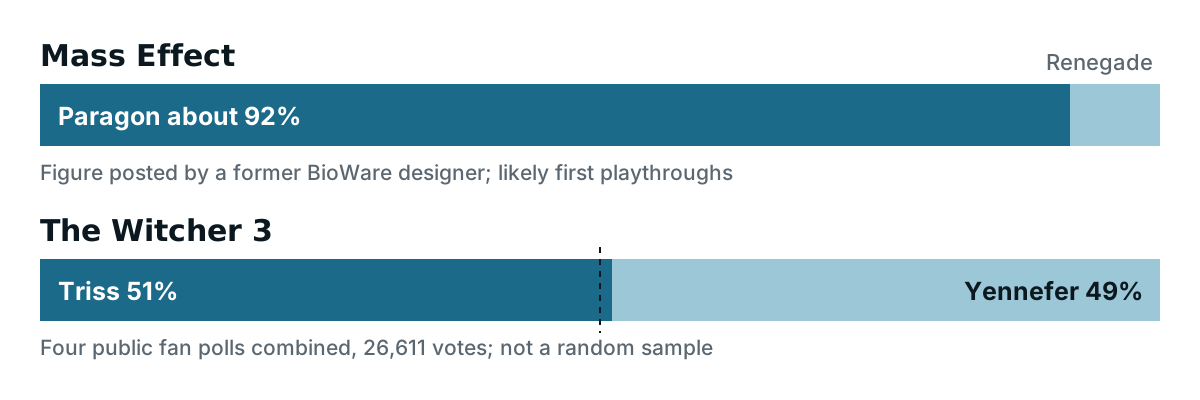
Mass Effect (BioWare, 2007) is the cleanest test. Across the trilogy, the player’s Commander Shepard builds up two scores. Paragon is the principled, compassionate route. Renegade is the ruthless one. BioWare wrote, voiced and animated both.
In February 2020, John Ebenger, a former BioWare cinematic designer, posted a figure: “Something like 92% of Mass Effect players were Paragon.” In the same post he made clear that the Renegade route had not been neglected by the team. The number needs its caveats. It is a tweet, not a dataset. Ebenger said it may have been collected close to release, before players went back for a second run. “Roughly nine in ten, on a first playthrough” is as far as it can carry.
It is not an isolated signal. Matt Boland, a narrative designer at Telltale, put it plainly: “People always want to be the good guy. The trick was always pitting what they wanted to do against what SHOULD do.” Larian’s first-anniversary figures for Baldur’s Gate 3, from August 2024, show that more than 93 percent of players built a custom character, and only 15 percent picked the Dark Urge, the origin written around murderous impulses. Even trivial choices cluster: Netflix reported that 73 percent of Bandersnatch viewers accepted the same job offer. All of these are company figures, and none is an audited sample.
The setting is what makes this strange. These worlds have no police, no reputation that follows you home, and a reload button. The cruel route is free. Lingard’s gamblers showed their greed when money was real. Players given a consequence-free world mostly show restraint.
Three explanations are usually offered, and each is probably part of the truth. The first is self-consistency: people play as who they are, or who they want to be, and cruelty feels wrong even when it costs nothing. The second is identification. Players say “I died,” not “Shepard died.” If the avatar is me, its cruelty is mine. This is what designers mean by player agency: the sense that a choice is your own and that the world answered it. The third is relationships. Writers make the characters in these worlds lovable, and hurting someone you have spent forty hours with feels like betrayal rather than an option on a menu.
Ebenger’s caveat fits this. Developers build evil paths that few players take on a first run, the run where the player is choosing for themselves. A good-or-evil meter is still a blunt instrument. A sharper test is a choice between two good options.
Triss, Yennefer and a snowball fight
The Witcher 3: Wild Hunt (CD Projekt Red, 2015) asks the player, as the monster hunter Geralt, to choose between two sorceresses. In Andrzej Sapkowski’s novels, Yennefer is Geralt’s great love. In the first two Witcher games, she is almost absent, and players spent their time with Triss instead. The third game makes you pick.
Nobody knows the result. CD Projekt Red has never published official numbers, and fan polls are not random samples. The largest is a Steam user’s tally of four public polls, reported by GAMINGbible in January 2023: 26,611 votes, 13,602 for Triss and 13,009 for Yennefer. That is 51 to 49, essentially a coin flip. The headline that “most players chose Triss” rests on a two-point gap in an unofficial count.
The choice was also a late addition. CD Projekt’s Adam Badowski told PC Gamer that the forced choice “wasn’t [there] from the beginning.” The team felt a lack of personal conflict, and “this decision was made pretty late, but it was great.” His own answer: “My choice will always be Yennefer.”
What a pick reveals has never been studied properly, so what follows are hypotheses, not findings. One is exposure. The mere-exposure effect predicts that people prefer what is familiar, and players of the earlier games had two games of Triss, while readers of the novels had a saga of Yennefer. The second is structure. Yennefer appears early and then disappears for long stretches, while Triss’s story runs through the city of Novigrad in the middle of the game. The third is temperament. Triss reads as warmth and ease, Yennefer as history, friction and intensity, and players who defend their choice tend to talk about what they value in a real relationship, not about magic.
Some players try to dodge the choice by romancing both, until a quest called “It Takes Three to Tango,” in which both women invite Geralt to a shared room, reveal that they know, leave him chained to the bed and walk out. Both romances end for good. In an early GameFAQs poll of 246 voters, 16.3 percent said they tried for both and were dumped. It is a joke with a point: refusing to choose is itself a choice, and the game registers it.
The deepest test in the game is not the romance. It is Ciri, Geralt’s adopted daughter. Her fate at the end depends on roughly five small moments that the game never flags as important. When she is low, Geralt can share a drink with her or start a snowball fight. He can let her face the sorceresses of the Lodge alone. He can encourage her to vent her anger. He can go with her to Skjall’s grave. And he can refuse the payment her father, Emperor Emhyr, offers for bringing her back. Guides disagree on exactly how many of these the good ending requires, so no threshold is given here.
My reading is that the choices share a pattern. The answers that help are ones of trust and presence. The ones that hurt are ones of control, management or payment. Players usually find out only at the ending that they were being judged as a parent the whole time. A novel can describe a good father, and a film can show one. This game checked whether the player would be one. It is Lingard’s card table turned into a design.
What the lab says
In 2012, Andrew Weaver and Nicky Lewis had 75 participants complete the Moral Foundations Questionnaire, a measure of real-world moral intuitions, and then play the first act of Fallout 3, which contains 17 moral choices they could code. Most players made the moral choice. They treated the characters, in the authors’ words, “as if these were actual interpersonal interactions,” and antisocial choices produced guilt. The paper’s title is Mirrored Morality.
In 2014, Matthew Grizzard and colleagues randomly assigned players to play either a terrorist or a UN soldier. The terrorists felt more guilt. More surprising, the guilt made the moral foundations they had violated, care and fairness, more salient afterwards. Grizzard summarised it this way: “Rather than leading players to become less moral, this research suggests that violent video-game play may actually lead to increased moral sensitivity.” This is one study with short-term measures, and Grizzard’s later work suggests the guilt can fade with repeated play. Tilo Hartmann and Peter Vorderer have documented the counterweight: players use moral disengagement, telling themselves “it’s just a game” or “they’re the enemy,” to enjoy virtual violence. Games can sharpen moral feeling, and they can train excuses. Which one happens depends heavily on design.
A third line of work asks who the player is being. Andrew Przybylski and colleagues found in 2012 that games were most intrinsically motivating when players experienced themselves as their ideal self during play. The effect was strongest for people with a large gap between who they are and who they wish to be, and for those who were highly immersed. People also play as the person they are trying to become. Larian’s data hint at how much that matters: Baldur’s Gate 3 players spent a combined 8,196 years in the character creator alone.
Motives differ, too. Richard Bartle’s 1996 player types came from one text-based MUD and were never meant as a personality test. Nick Yee’s Quantic Foundry model, built on surveys of hundreds of thousands of gamers, finds that the appetite for competition drops steeply with age and that gender differences are smaller than stereotypes suggest.
Then the mirror starts to look back. In 2007, Nick Yee and Jeremy Bailenson gave people different bodies in virtual reality and named what followed the Proteus effect: “an individual’s behavior conforms to their digital self-representation.” Participants given more attractive avatars stood closer to others and disclosed more about themselves. Those given taller avatars negotiated more aggressively. A 2009 follow-up found the height effect carried over into a face-to-face negotiation afterwards. The avatar is not only a costume. It shapes the player.
The most striking study is Mel Slater’s virtual reprise of Milgram’s obedience experiments in 2006. Thirty-four participants were asked to give “shocks” to a virtual woman, and every one of them knew she was a computer character. Of the 23 who could see and hear her, six withdrew before giving all 20 shocks, and that group showed raised skin conductance and heart-rate changes. The 11 who dealt with her only through text were far less affected. The authors wrote that participants responded “as if it were real.” Knowing that a scene is fiction does not switch off the part of a person that responds to it. Presence beats knowledge.
At scale, that response can make a game into an accidental simulation. In 2005, a buggy plague called Corrupted Blood escaped a raid in World of Warcraft and swept its cities. Some healers rushed toward the infected; some players spread it on purpose. Epidemiologists Eric Lofgren and Nina Fefferman later studied that behaviour as a model for a real outbreak.
The mirror can also be rigged. BioShock spends hours having a friendly voice say “Would you kindly,” then reveals that the phrase was a trigger and the player’s obedience was scripted. The Stanley Parable is built around a narrator who tells you which door to take. Both are satires of game choice made with game choice. A game can only reveal you within the choices its designers chose to offer. That is the limit on everything in this essay.
Pocket, desk, couch, headset
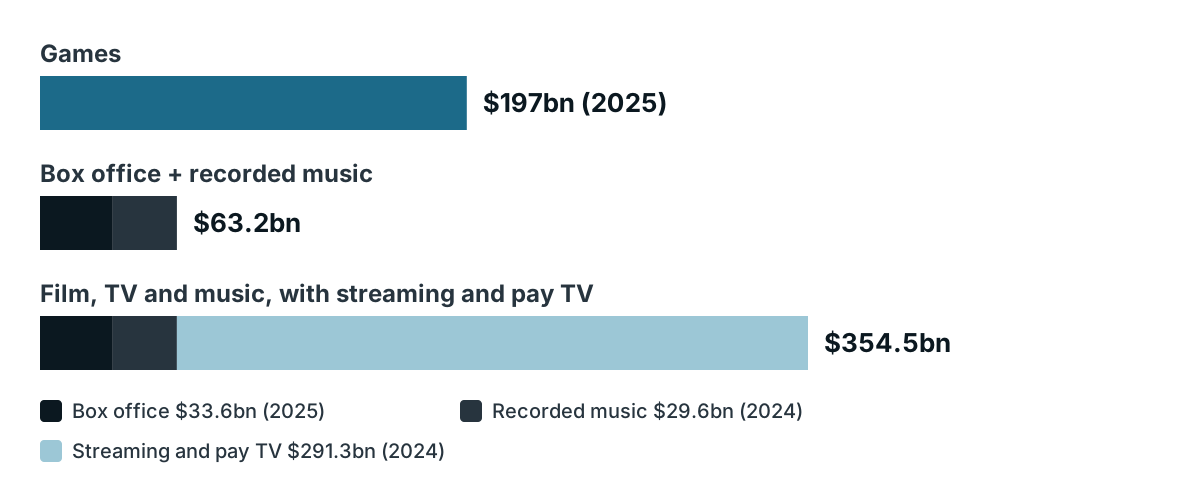
Where people play changes what the mirror can show. Newzoo counted 3.58 billion players in 2025, six in ten of the world’s internet users, and in December 2025 revised its revenue forecast up to $197 billion, 7.5 percent higher than the year before. The familiar line that games are “bigger than film and music combined” holds only in a narrow form. Against global box office ($33.6 billion, Gower Street, 2025) plus recorded music ($29.6 billion, IFPI, 2024), $197 billion is three times larger. Add streaming and pay TV ($291.3 billion, PwC, 2024) and film, TV and music together come to about $354.5 billion, well above games.
Mobile is the bulk of it: about 3 billion players, 83 percent of the total, and more than half of the money. Many of them would not call themselves gamers, yet by headcount they are the medium. Sessions are short. Notifications call the player back, and rewards often arrive on a variable-ratio schedule, the unpredictable payout pattern slot machines use, building a feedback loop that runs from one session into the next. Free-to-play economics lets a small share of heavy spenders, known in the industry as whales, fund the game for everyone else. As another essay on this site argues, a game is industry, art and media at once, and on a phone the industry side is often the one doing the designing.
Jesper Juul’s A Casual Revolution (2010) argues that “casual” describes how flexibly a game fits into life, not how deep the player is. Honor of Kings has a fiercely competitive scene, and Genshin Impact players log hundreds of hours. The real line runs between a commute and an evening, not between kinds of people. Mobile also offers strong evidence of a game changing behaviour outside itself. Tim Althoff, Ryen White and Eric Horvitz analysed 31,793 Microsoft Band users and found that engaged Pokémon GO players added 1,473 steps a day, an increase of more than 25 percent. The authors estimated that the game added 144 billion steps to US physical activity in a month, and that it reached low-activity people that health apps miss. Follow-up research found the boost faded over weeks.
PC, with about 936 million players, and console, with about 645 million, are where people lean in, and where the long role-playing games above mostly live. The walls are thinning: the Switch 2 is a console you carry, and the Steam Deck is a PC in your hands. “Platform” increasingly describes a posture and a time of day rather than a box.
Virtual reality is where presence is strongest. In 1998, Matthew Botvinick and Jonathan Cohen showed that the brain will adopt a rubber hand when it is stroked in sync with the hidden real one; VR extends that illusion to the whole body. People standing on a virtual plank high above a city feel their legs shake, though the real plank lies flat on the carpet. At the University of Washington, Hunter Hoffman and David Patterson built SnowWorld, in which burn patients throw snowballs at penguins during wound care. The university reports a 40 to 50 percent drop in pain, and the patients who felt most present got the most relief.
Commercially, though, headsets are shrinking. According to IDC, Meta shipped 5.6 million Quest headsets in 2024 and 1.7 million in the first three quarters of 2025, down 16 percent year on year. IDC’s December 2025 release forecast that virtual and mixed reality headset shipments would fall 42.8 percent in 2025, while the rest of the category, mainly smart glasses, grew 211.2 percent. Meta launched display glasses, not a new Quest, in autumn 2025. The usual reasons given are weight, motion sickness, isolation from the room, price and setup effort.
Every one of these platforms offers interactivity. What differs is how much of the player each one asks for. My reading of the market is that immersion was never the bottleneck. Convenience was. The phone wins because it asks almost nothing, and the headset struggles because it asks for the whole body.
The machine and the mirror
Part 1 described a ladder with three steps: telling, showing, doing. VR adds a fourth, being, where the body is in the scene. The next step is already in demos: AI characters that answer anything, and stories generated as they are played. The promise is Janet Murray’s Holodeck, a world without edges or a script.
That promise deserves caution, for a reason that runs through every example above. The quest that punishes you for refusing to choose, the daughter whose fate rests on a snowball fight, the shock button six people refused to keep pressing: each worked because someone built a limit and made the player feel it. A choice has weight because something else was closed off. Even a sandbox, which leaves goals to the player, keeps firm rules so that free play has something to push against. Infinite content can easily become weightless content. Today’s AI demos are experiments, not proof.
Nor is the mirror harmless. The WHO’s ICD-11 has included gaming disorder since 2022. The diagnosis is contested and affects a small minority of players, but a medium this absorbing cuts both ways.
The best frame for all of this comes from 1974. In Anarchy, State, and Utopia, Robert Nozick asks whether you would plug into a machine that gives you any experience you want, indistinguishable from the real thing, for the rest of your life. Most people say no. We want to actually do things and to actually be a certain kind of person, not only to have the experience of it. Games are the nearest thing we have built to Nozick’s machine. The evidence in this essay says they matter for the opposite reason.
A game’s world is fake, but the choices made in it are real, and that is why it can show you who you are.
The nine in ten who chose kindness did choose it. The player who let Ciri walk into the Lodge alone did trust her. The six participants who stopped pressing the button did refuse. Lingard’s point survives the trip from the card table: absorbed in a game, people stop performing.
That does not make games the highest art. Novels still own the inside of a mind, and film still controls attention more precisely than any game. Most players never reach the ending: Bailey and Miyata’s 2019 study of 725 Steam games found a median completion rate of 10 percent. What games are is the most complete participation any medium offers. A book lets you imagine a life and a film lets you witness one. A game lets you act in one, then shows you what you did, and the audience becomes the author of its own guilt, pride and loyalty.
Games Are the Ultimate Experience, in 2 parts
- Part 1Why Games Hit Harder Than Books and Movies
- Part 2What Your Choices in Games Say About You (this essay)
Video chapters
Terms in this essay
Games discussed
- Mass EffectBioWare, 2007
- The Witcher 3: Wild HuntCD Projekt Red, 2015
- Baldur's Gate 3Larian Studios, 2023
- Fallout 3Bethesda Game Studios, 2008
- BioShock2K Boston, 2007
- The Stanley ParableDavey Wreden, 2011
- World of WarcraftBlizzard Entertainment, 2004
- Pokémon GONiantic, 2016
Sources and further reading
- ArticleMost Mass Effect players chose to play the good guy. TechSpot, 2020. Reports John Ebenger's February 2020 tweet. A developer's recollection, not a published dataset; he said the figure may date from near launch.
- PaperMirrored Morality: An Exploration of Moral Choice in Video Games. Cyberpsychology, Behavior, and Social Networking, 2012.
- PaperBeing Bad in a Video Game Can Make Us Morally Sensitive. Cyberpsychology, Behavior, and Social Networking, 2014. One study with short-term measures.
- Article'Bad' video game behavior increases players' moral sensitivity. University at Buffalo, 2014.
- PaperA Virtual Reprise of the Stanley Milgram Obedience Experiments. PLoS ONE, 2006.
- PaperThe Ideal Self at Play: The Appeal of Video Games That Let You Be All You Can Be. Psychological Science, 2012.
- PaperThe Proteus Effect: The Effect of Transformed Self-Representation on Behavior. Human Communication Research, 2007.
- PaperThe Proteus Effect: Implications of Transformed Digital Self-Representation on Online and Offline Behavior. Communication Research, 2009.
- PaperIt's Okay to Shoot a Character: Moral Disengagement in Violent Video Games. Journal of Communication, 2010.
- BookA Letter of Advice to a Young Gentleman Leaving the University. Dublin (EEBO-TCP text, Oxford Text Archive), 1670. The real source of the "hour of play" line usually credited to Plato. Reprinted in New York in 1696. Reading list
- ArticleQuote Origin: You Can Discover More About a Person in an Hour of Play than in a Year of Conversation. Quote Investigator, 2015.
- ArticleFact Check: Did Plato Say, 'You Can Discover More About A Person In An Hour Of Play Than In A Year Of Conversation'?. Check Your Fact, 2019.
- ArticleNew Baldur's Gate 3 player stats reveal how many people banged the bear. TechRadar, 2024. Larian's first-anniversary infographic (7 August 2024). Company figures.
- ArticleBaldur's Gate 3 has a total playtime of over 51,000 years, new stats show. TechRadar. Larian's figure for time spent in the character creator.
- WebsiteTriss or Yennefer: combined tally of public polls. Steam Community. A fan's aggregation of four polls, 26,611 votes. Not a random sample and not official data.
- WebsiteTriss or Yen: Who did you choose and why?. GameFAQs. Early forum poll, 246 votes.
- InterviewThe Witcher 3 didn't originally make you choose between romancing Yennefer or Triss: 'This decision was made pretty late'. PC Gamer.
- Article9 out of 10 Mass Effect Players Chose the Compassionate Paragon Route, Reveals Former Dev. PlayStation LifeStyle, 2020. Source of the Matt Boland (Telltale) quote.
- ArticleBlack Mirror: Bandersnatch choices. /Film, 2019. Figures from Netflix's own social posts.
- PaperThe untapped potential of virtual game worlds to shed light on real world epidemics. The Lancet Infectious Diseases, 2007.
- ArticleThe global games market is forecast to reach $197bn in 2025. PocketGamer.biz, 2025. Newzoo figures, revised December 2025.
- PaperInfluence of Pokémon Go on Physical Activity: Study and Implications. Journal of Medical Internet Research, 2016.
- PaperRubber hands 'feel' touch that eyes see. Nature, 1998.
- ReportGlobal XR shipments rebound behind glasses-first momentum. IDC, 2025.
- ArticleHeadset hype meets harsh reality as Apple and Meta VR shipments fizzle in 2025. The Register, 2026. Reports IDC shipment figures for Meta Quest.
- ArticleHardly anyone finishes games. Digitec. Reports Bailey and Miyata (Entertainment Computing, vol. 31, 2019): median completion of 10% across 725 Steam games.
- PaperHearts, Clubs, Diamonds, Spades: Players Who Suit MUDs. 1996.
- WebsiteGamer motivation research. Quantic Foundry.
- BookA Casual Revolution: Reinventing Video Games and Their Players. MIT Press, 2010. Reading list
- BookAnarchy, State, and Utopia. Basic Books, 1974. Reading list
Second Playthrough is reader-supported. Members read every essay before the video goes live. Support the channel →